A complete end-to-end system smart affiliates use to turn AI into revenue — without becoming spammy or lazy.
The Problem With “AI Hacks”
If you spend more than five minutes on YouTube, Twitter, or in a Facebook group for affiliates, you’ll see it:
“10 AI Prompts That Will Explode Your Affiliate Sales.”
“Copy This Prompt to Make Passive Income.”
“Let ChatGPT Build Your Entire Business.”
It’s tempting. I get it.
When you’re juggling content, keywords, emails, offers, and analytics, the idea that one magical prompt could shortcut the whole process feels… relieving.
But here’s the uncomfortable truth:
Hacks don’t scale.
They might give you a quick win. They might even help you publish faster for a week or two. But they don’t build something stable. They don’t create consistency. And they definitely don’t create predictable commissions.
Random prompting creates random results.
You ask AI for blog ideas one day. The next day you ask it to write a comparison post. The next day you tell it to “optimize for SEO.” There’s no connective tissue. No sequence. No structure tying it together.
So your output feels scattered.
Your monetization feels inconsistent.
And your results feel… confusing.
This is where most affiliates quietly get frustrated.
They think the problem is the tool.
Or the niche.
Or the algorithm.
It’s not.
AI doesn’t make you money. A workflow does.
High-performing affiliates don’t use AI like a slot machine, pulling the lever and hoping for gold. They use it inside a repeatable pipeline — a structured sequence where each step feeds the next.
Idea → Validation → Creation → Monetization → Optimization.
The AI isn’t the strategy. It’s the assistant inside a system.
And once you start thinking that way, everything changes.
Read our full guide to AI affiliate marketing to learn more.
The Affiliate AI Workflow (Big Picture)
So if hacks aren’t the answer… what is?
A workflow.
Not a complicated, over-engineered system. Just a clear, repeatable sequence that turns a vague idea into a real commission.
Here’s the big picture:
Stage One: Idea Generation
Stage Two: Keyword & Buyer Intent Analysis
Stage Three: Content Creation
Stage Four: Monetization & Updating
That’s it. Four stages. Simple on the surface. Powerful when done intentionally.
But here’s where most people go wrong — they treat all AI prompts the same.
They use one generic “write me a blog post” prompt for everything. Brainstorming. Research. Drafting. Optimizing. Updating.
And that’s like using a hammer for every job in your toolbox.
Each stage in this workflow has a different purpose.
Idea Generation is about uncovering pain, desire, objections, and buying triggers.
Keyword & Buyer Intent Analysis is about validating whether that idea actually has commercial potential.
Content Creation is about structuring and delivering value in a way that builds trust.
Monetization & Updating is about turning attention into income — and keeping it that way.
Each stage requires different prompts because each stage is solving a different problem.
And more importantly, each stage prevents a different kind of mistake.
Stage One prevents you from writing about things no one cares about.
Stage Two prevents you from chasing traffic that won’t convert.
Stage Three prevents you from publishing fluff.
Stage Four prevents you from leaving money on the table.
When you zoom out, you start to see something important:
Affiliate marketing isn’t about content.
It’s about flow.
One stage feeds the next. One decision shapes the next outcome.
And when AI is plugged into the right stage — with the right instructions — it stops being a novelty and starts becoming leverage.
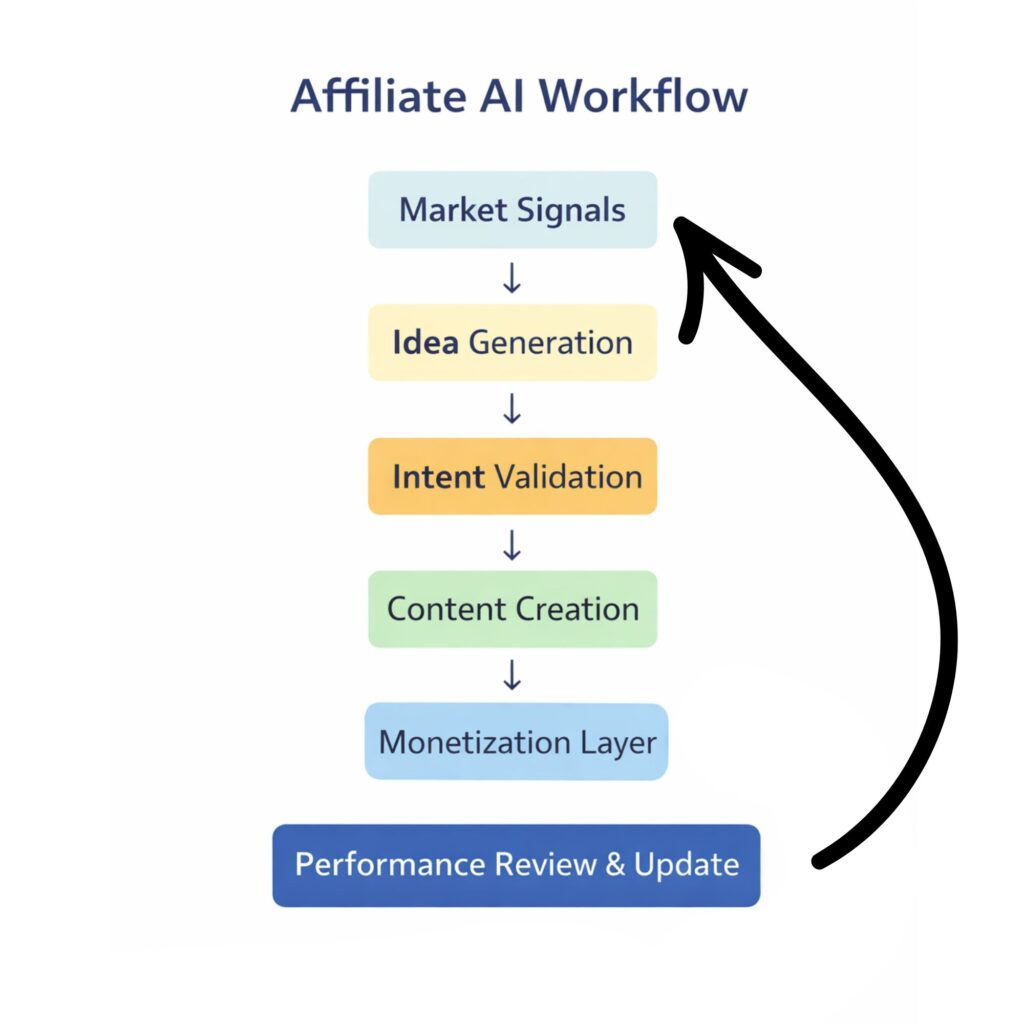
Or simplified:
Human Insight → AI Ideation → AI Research → Human Edit → Publish → Optimize
Want the exact prompts we use at each stage?
Stage 1 — Idea Generation (Without Guessing)
This is where most affiliate marketers quietly waste months.
They open ChatGPT and type:
“Give me blog ideas about fitness.”
“Give me 20 affiliate post ideas.”
“What should I write about next?”
And to be fair — AI will happily give you something.
But “something” isn’t the same as strategic.
AI is not for random brainstorming.
It’s for extracting signals.
Instead of asking for generic ideas, you use AI to uncover:
Real pain points people are actively trying to solve
Buyer hesitations that slow down decisions
Product comparison angles that create natural review content
Seasonal timing opportunities that increase urgency without hype
That’s a completely different mindset.
You don’t ask AI:
“Give me blog ideas.”
You give it:
A clear niche ( you can use AI for affiliate product research)
A defined buyer persona
A specific monetization goal
Because here’s the rule:
Bad input = fluffy output.
If you give AI something vague, it will give you something vague back. Broad ideas. Generic titles. Surface-level topics.
But when you anchor it with:
“Beginner home gym owners with limited space”
“Budget-conscious dog owners worried about joint health”
“Parents shopping for a safe first laptop for a teen”
Now it starts producing angles that feel grounded. Relevant. Commercial.
Instead of “Top 10 Dumbbells,” you get:
“Best Adjustable Dumbbells for Small Apartments (When Space Is Tight)”
“Are Cheap Dumbbells a Waste of Money? What to Know Before Buying”
“Winter Joint Support for Senior Dogs: What Actually Helps?”
See the difference?
Inside the AI Starter Toolkit, we don’t leave ideation to chance.
We use a structured Pain → Purchase → Objection framework that consistently surfaces high-converting content angles.
Very simplified, it looks something like this:
Identify a specific pain or desire.
Clarify what the buyer is considering purchasing to solve it.
Surface the main objection holding them back.
That tension — between problem, solution, and hesitation — is where strong affiliate content lives.
But that’s just the surface version.
The exact prompt we use inside the toolkit walks AI through that structure in a way that produces angles that are not just interesting… but monetizable.
Because the goal isn’t to generate ideas.
It’s to generate ideas that lead somewhere.
Stage 2 — Keyword & Buyer Intent Analysis
This is where most affiliate strategies quietly fall apart.
Not because the content is bad.
Not because the niche is wrong.
But because intent was never clarified.
Most affiliates chase keywords.
Search volume.
Low competition.
Trending phrases.
What they don’t ask is:
Why is someone searching this in the first place?
That question changes everything.
Before you write a single word, every keyword should fall into one of four buckets:
Informational
The reader wants to learn.
“What is…”
“How does…”
“Why does…”
They’re not shopping yet. They’re understanding.
Comparison
The reader is evaluating options.
“Best…”
“X vs Y…”
“Is ___ worth it?”
They’re close — but cautious.
Transactional
The reader is ready to act.
“Buy…”
“Discount…”
“Best price for…”
They don’t want education. They want the right link.
Problem-Aware
The reader feels something isn’t working.
“Why does my…”
“How to fix…”
“Why isn’t…”
They may not even know which product solves it yet.
Now here’s the mistake:
Affiliates write transactional CTAs on informational content.
Or soft educational content for high-intent comparison keywords.
When intent doesn’t match the monetization stage, conversion suffers.
You might rank.
You might even get clicks.
But readers hesitate. Bounce. Or ignore your links entirely.
Because the ask doesn’t match their mindset.
Here’s the reality:
Traffic without intent is vanity. Intent without structure is wasted.
AI can help here — if you use it correctly.
Instead of asking AI to “find keywords,” you ask it to:
Classify keywords by intent
Identify buyer readiness
Suggest appropriate content format
Recommend CTA pressure level
That way, before you ever draft an article, you already know:
Is this an educational guide?
A comparison piece?
A review with a clear verdict?
Or a high-intent product page?
Inside the AI Starter Toolkit, we include a prompt that forces AI to categorize keywords by buyer stage before you write a single word.
Not after you publish.
Not when conversions are low.
Before.
Because once intent is clear, writing becomes easier — and monetization becomes natural instead of forced.
Stage 3 — Content Creation (Human in Control)
This is the stage everyone talks about.
And ironically, it’s the stage most people misuse.
If you’ve read our earlier piece, “How Smart Affiliates Use AI Without Becoming Spammy or Lazy,” you already know the core philosophy:
AI is a tool.
Not a replacement.
When content starts sounding robotic, generic, or overconfident, it’s not because AI is “bad.”
It’s because the human disappeared from the process.
Here’s what smart affiliates actually do:
AI drafts.
Humans decide.
AI structures.
Humans inject experience.
AI expands.
Humans filter fluff.
That difference is everything.
The Simple Creation Structure
Instead of asking AI to “write the whole article and call it done,” use a sequence:
AI → Outline
Get structure first. Headings. Logical flow. Gaps filled.
AI → First Draft
Let it expand the framework. Not perfectly. Just thoroughly.
Human → Tighten
Cut repetition. Clarify examples. Add nuance. Adjust tone.
This is where trust is built.
AI → SEO Pass
Ask for heading optimization, FAQ additions, semantic keyword layering.
Human → Final Edit
Add real-world context.
Remove exaggeration.
Adjust CTA strength.
Make it sound like you.
That’s the rhythm.
AI accelerates the heavy lifting.
But the human owns:
Judgment
Tone
Ethics
Persuasion
AI should accelerate thinking — not replace it.
If you ever feel like you’re just copying and pasting without editing, that’s your signal something’s off.
Strong affiliate content feels guided, not generated.
Read my article about getting better outputs from your AI prompts.
And here’s where this connects directly to the Starter Toolkit.
Inside the AI Starter Toolkit, we don’t just give you “write an article” prompts.
We include a structured draft + refinement sequence — designed to:
Produce stronger outlines
Improve clarity before publishing
Optimize without stuffing
Preserve trust
It’s not about pushing more content out.
It’s about turning one piece of content into something that actually converts.
Because publishing faster doesn’t build commissions.
Publishing intentionally does.
Stage 4 — Monetization & Updating (The Overlooked Stage)
This is where the real money is made.
And it’s also where most affiliates quietly stop.
They publish.
They add a link.
They move on.
Maybe they check rankings once or twice. Maybe they refresh a headline. But the content? It mostly sits.
You’re positioning yourself differently.
Because publishing is not the finish line.
It’s the midpoint.
Monetization Is a Layer — Not an Afterthought
Smart affiliates don’t just “insert links.”
They build a monetization layer into the content intentionally.
And this is another place AI can help — if you use it correctly.
AI can:
Suggest contextual affiliate placements that don’t interrupt flow
Identify weak or vague CTAs that aren’t pulling clicks
Rewrite product blurbs to focus on benefits instead of features
Analyze top-ranking competitors and surface gaps
Generate update checklists so you don’t miss opportunities
Notice the pattern?
AI isn’t guessing.
It’s auditing.
It’s refining.
It’s tightening the conversion mechanics after the content already exists.
That’s a very different use case than “write me an article.”
The Updating Cycle Most Affiliates Ignore
Content isn’t static. Buyer behavior changes. Products evolve. Competitors improve.
So your content should evolve too.
A simple rhythm looks like this:
Quarterly refresh
Add new products if the market shifted
Improve conversion blocks (better verdict section, clearer CTAs)
Update comparisons with newer models
Strengthen FAQs based on real search behavior
When you treat content like an asset instead of a post, something powerful happens.
Commissions compound when content evolves.
A page that earns five dollars a month can become fifty — not because you rewrote it from scratch, but because you refined it.
Inside the AI Starter Toolkit, we include prompts specifically designed for:
Content refresh
CTA improvement
Ethical persuasion adjustments
Conversion alignment
Because monetization isn’t about pushing harder.
It’s about tightening what already works.
And that’s the stage most affiliates never build into their system — which is exactly why it becomes your advantage.
Putting It All Together (Systems > Hacks)
Let’s zoom out.
Hacks feel exciting.
New prompts.
New tools.
New “secret strategies.”
They give you a quick dopamine hit. A sense of movement. A feeling that something big might happen.
But dopamine isn’t the same thing as durability.
Hacks create activity.
Workflows create income.
When you build around hacks, every week feels like starting over.
When you build around systems, each piece of content stacks on the last.
That’s the difference.
Smart affiliates don’t:
Chase every new AI feature
Rebuild their process every month
Swap tools constantly
Publish randomly and hope something sticks
They build processes.
They know:
Where ideas come from
How intent gets validated
How content gets structured
How monetization gets layered
When optimization happens
And they use AI as a leverage layer inside that process.
Not the brain.
Not the boss.
The accelerator.
AI becomes the assistant that makes a strong system faster and cleaner.
Without a system, AI just creates more noise.
With a system, AI multiplies output without multiplying confusion.
Let’s recap the full workflow:
Stage One — Idea Generation
Extract pain points, hesitations, and monetizable angles.Stage Two — Keyword & Buyer Intent Analysis
Match content to buyer readiness before writing.Stage Three — Content Creation (Human in Control)
Use AI to draft, but apply judgment and refinement.Stage Four — Monetization & Updating
Layer conversion intentionally and improve over time.
That’s the difference between “trying AI” and building an affiliate engine.
Because predictable income doesn’t come from a prompt.
It comes from a repeatable path.
And once that path exists, AI stops being a novelty…
And starts becoming leverage.
What Happens Next?
You have two options.
You can close this tab, open ChatGPT, and start experimenting.
Or you can take the structure you just read and apply it with prompts that are already built for this exact workflow.
No hype. No pressure. Just clarity.
Option A: Direct Toolkit Path
Stop Guessing. Start Using a Proven Workflow.
You could reverse-engineer everything in this article.
Piece together your own ideation framework.
Figure out how to classify intent manually.
Test draft structures until something converts.
Or…
You could use the exact prompts we use inside our affiliate projects.
The AI Starter Toolkit was built around the same four-stage workflow you just read about. It gives you:
A structured ideation framework (Pain → Purchase → Objection)
A buyer-intent classification prompt that aligns content before you write
A conversion-focused draft system that keeps humans in control
Monetization enhancer prompts to tighten CTAs and placements
Updating checklist prompts so content compounds instead of stagnates
It’s not a “magic prompt bundle.”
It’s a practical execution layer for a repeatable affiliate system.
If you want structure instead of guesswork:
👉 Steal the AI Starter Toolkit
Option B: Newsletter Path
Want Smarter AI Workflows Like This?
Not every affiliate needs a full toolkit today.
Some just need better thinking.
Each week, we break down one practical system affiliates can apply immediately — whether that’s improving intent alignment, tightening monetization, or simplifying content creation.
No hype.
No guru energy.
No “make money in 24 hours” nonsense.
Just calm, structured leverage you can use in the real world.
If you prefer to build steadily and think long-term:
👉 Join the Affiliate AI Newsletter (You’ll get our FREE 7-Day AI Niche Finder Challenge to find the perfect niche for your business!)
Whatever path you choose, remember:
Affiliate marketing isn’t about chasing trends.
It’s about building repeatable processes that compound over time.
Tools change.
Platforms change.
Algorithms change.
Systems endure.
Build one.