Why Most Affiliate Content Fails
Most affiliates don’t fail because they’re bad writers. Although, to be perfectly honest, some are. I’ve seen a few. Most affiliates fail because they promote products no one is emotionally ready to buy.
They:
Pick trending products
Copy competitor headlines
Skim star ratings
Write generic “best of” lists
And then wonder why traffic doesn’t turn into commissions.
Well, maybe your potential customers aren’t at the point in their journey where they’re ready to buy. AI can pump out all the writing you want, but if you don’t understand your buyers, it won’t matter.
AI is best used not to write all your content for you, but to help you understand who you should be writing for.
If you use AI for affiliate marketing correctly, you can:
Decode reviews
Spot real buying signals
Identify emotional triggers
Fill content gaps competitors ignore
That’s really how you should use AI in affiliate marketing research. Let’s break this down even further.
(If you’d like to learn about all the ways you can use AI in affiliate marketing, check out my complete guide to AI affiliate marketing.
Reading Reviews With AI (Without Getting Lazy)
Why Reviews Are Gold
A well-written product review is going to tell you about the customer, not just the product.
It will tell you things like:
Pain points
Desired outcomes
Objections
Comparisons
Language buyers actually use
But manually reading 300 reviews per product is exhausting.
This is where AI becomes your research assistant.
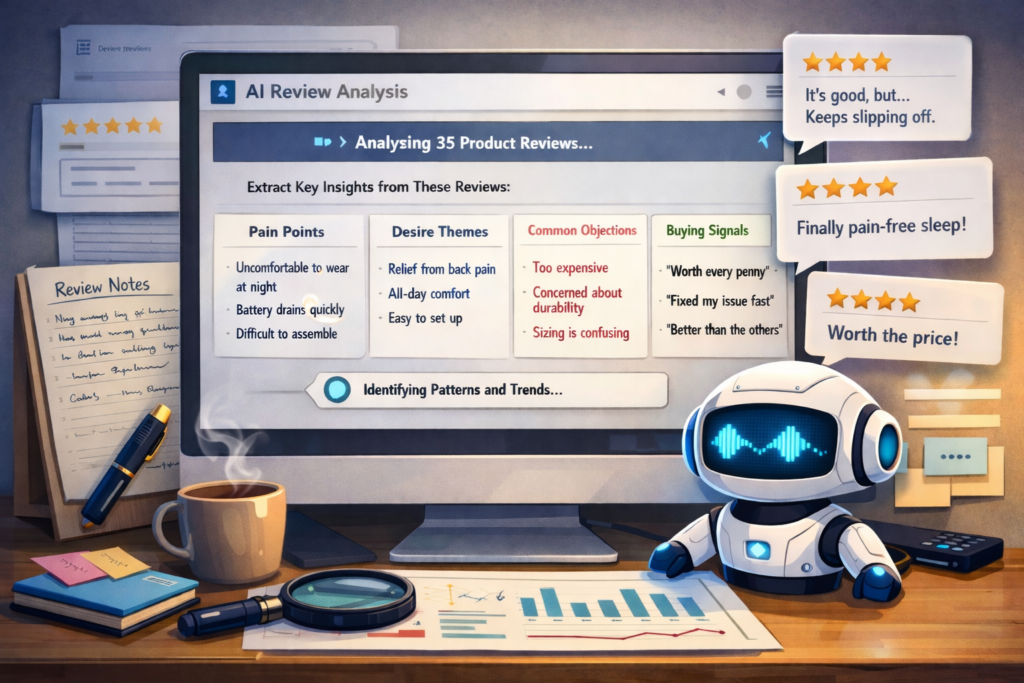
Extract Emotional Themes
In order to determine pain points, desired outcomes, objections, etc, you’ll need to look at a variety of reviews, not just 5 star. Reviews lower than 5 star is where you’re going to see objections and obstacles that need to be addressed.
Here are the steps to making AI your research assistant:
Copy 20–50 reviews (mix 3-star and 4-star — not just 5-star).
Paste into AI.
Use structured prompts to analyze patterns.
Core Prompt Example
Analyze these product reviews.
Extract:
Common complaints
Recurring praise
Emotional language used
Situations where the product failed
Situations where the product exceeded expectations
Phrases that signal urgency or relief
To learn more about AI prompting, read about writing better prompts for AI research.
What You’re Actually Looking For
Now that you have this analysis, you’re going to want to break into categories:
Pain points
Desired transformation
Repeated objections
Unexpected use cases
Buyer sophistication level
This is going to shape how you create and present your content.
Instead of:
“Best Knee Brace for Support”
You write:
“Best Knee Brace for Nighttime Pain That Wakes You Up”
Specific is better than generic. Generic is a bigger pool of customers, but specific customers are more likely to buy, especially when you address their specific pain points. Yeah, someone who needs a knee brace might buy, but someone who’s looking for a knee brace specifically to address nighttime pain that wakes them up is much more likely to buy.
Spotting Buying Signals (This Is Where Conversions Happen)
What Is a Buying Signal?
A buying signal is not “I love this.” There are a lot of things I love that I would NOT buy for various reasons such as affordability, fit with my lifestyle, lack of storage, etc.
A buying signal is:
“I tried three others before this one.”
“Worth the money.”
“I was skeptical but…”
“Fixed my problem in two days.”
“Finally…”
These are conversion triggers. These say to your potential customers “I found the solution to my problem. This might work for you, too.”
How to Train AI to Identify Buying Signals
How do you train AI to help you identify buying signals?
Here’s a prompt example to follow up with in the same chat after AI analyzes your sample reviews:
From these reviews, identify:
Statements that indicate high purchase intent
Language showing hesitation before buying
Comparisons to competing products
Mentions of price justification
Words signaling urgency or desperation
AI can categorize these signals for you into:
Urgency
Relief
Frustration threshold
Value defense
Risk mitigation
This information will help you structure:
Headlines
FAQ sections
Objection handling
Comparison tables
When you address all the reasons they have to NOT buy, you reduce the friction from their decision TO buy.
Identifying Content Gaps Competitors Miss
Let’s just be honest here. Many affiliates work with idea that quantity is what will work for them. The faster they pump out content, the better. I know, I used to work that way too. And you may get some sales that way. I did. Once I figured out quality converts better, I stopped:
Looking at top-ranking posts
Copying structure
Changing wording
And started looking at:
What’s missing
What’s glossed over
What buyers complain about but competitors ignore
Let’s walk through how you can get AI to help you identify content gaps your competitors miss.
Step 1: Analyze Competitor Articles
You will guide AI into identifying the pain points, objections, and desired not addressed.
An example prompt:
Analyze this competitor article.
Identify:
Questions not fully answered
Objections not addressed
Overly generic sections
Missing buyer scenarios
Assumptions made without proof
Step 2: Cross-Reference With Reviews
At this point, you’ll want to combine review complaints with your competitor’s blind spots. This will reveal content gaps.
Example:
If reviews say:
“It slips during workouts”
And competitors never mention that…
That’s your angle.
The Pain Point Matrix
To effectively organize this information, build a grid.
| Pain | Desire | Objection | Buying Trigger |
|---|---|---|---|
Use AI to populate this from review data.
This grid now becomes your:
Outline
Hook source
FAQ engine
Comparison strategy
Now, we transform this pain point matrix into content that converts!
Turning Research Into Content That Converts
This is where most affiliates drop the ball.
They do some research.
They skim a few reviews.
Then they default to generic headlines and templated content.
But if you’ve actually used AI to extract pain points, objections, and buying triggers…
You now have conversion gold.
The difference between traffic and commissions often comes down to one thing:
Did you reflect the buyer’s real problem back to them?
Let’s turn your research into assets that convert.
Headlines: Lead With the Pain (or the Relief)
Your review analysis probably surfaced phrases like:
“I have a sensitive stomach…”
“I tried three others before this one.”
“I was skeptical, but…”
“Finally something that doesn’t…”
“Worth the money even though…”
Those are headline ingredients.
Instead of writing:
Top Protein Powder Review
You write:
The Only Protein Powder That Doesn’t Upset Sensitive Stomachs (Based on 247 Reviews)
See the difference?
Specific problem
Clear audience
Implied social proof
Data-backed authority
Specificity signals research.
Research signals trust.
Trust converts.
Other transformations:
Generic:
Best Knee Brace for Running
Research-Driven:
Best Knee Brace for Runners With Nighttime Swelling (What 300 Reviews Reveal)
Generic:
Budget Standing Desk
Research-Driven:
A Standing Desk That Doesn’t Wobble Under Dual Monitors (Even Under Load)
Your AI research tells you what buyers actually care about.
Your headline should reflect that.
Subheads: Address Objections Before They Leave
From your review analysis, you likely found objections like:
“It runs small.”
“Not great for wide feet.”
“Battery life wasn’t as advertised.”
“Customer service was slow.”
Turn these into subheads:
Does It Actually Fit True to Size?
How It Performs Under Heavy Use
Is It Worth the Price Compared to X?
Who This Is NOT For
When readers see their concern acknowledged, something powerful happens:
They stay.
Because now it feels like you understand them, like you are solving their problem with care, not just trying to sell to them.
Comparison Charts: Structure Around Buying Signals
Don’t just compare specs.
Compare what buyers emotionally compare.
If reviews mention:
“Worth the extra money”
“Cheaper than Brand X”
“More durable”
“Easier to clean”
Your chart shouldn’t just show:
| Product | Price | Weight | Size |
It should show:
| Product | Best For | Handles Heavy Use? | Good for Sensitive Users? | Price Justified? |
Your research tells you what buyers are debating internally.
Mirror that debate in your table.
That’s persuasive.
FAQs: Mine the 3-Star Reviews
Three-star reviews are a gold mine.
They usually say:
“It’s good, but…”
“I wish it…”
“It works unless…”
These become FAQ sections:
Does It Slip During Workouts?
Is It Comfortable for All-Day Use?
What Happens If It Doesn’t Work for You?
How Long Does It Actually Last?
When you answer real concerns (not imagined ones), you reduce hesitation.
Reduced hesitation = higher conversion probability.
Callouts: Highlight Buying Triggers
Your AI likely identified phrases like:
“Finally.”
“Instant relief.”
“Saved me.”
“Game changer.”
“I was skeptical but…”
Turn those into visual callouts:
✔ “Finally something that doesn’t dig into my skin.”
— Verified Buyer
Or:
Best For: People who’ve already tried cheaper alternatives and are tired of replacing them.
These micro-moments reinforce emotional validation.
Email Angles: Sell the Problem, Not the Product
Instead of:
Check out this new protein powder.
Try:
Subject Line:
“I was skeptical, but…”
Body angle:
Tell the story of the hesitant buyer you found in reviews.
Frame it around:
Frustration
Failed attempts
Relief moment
Example:
“I kept seeing reviews from people with sensitive stomachs who had basically given up. Then I noticed something interesting…”
Now your email feels like insight — not a pitch.
Pinterest Angles: Speak to Situations, Not Products
Pinterest users search by situation.
Your research probably surfaced use cases like:
Night pain
Postpartum recovery
Travel
Long work shifts
Gym beginners
Seniors
Instead of:
Best Knee Brace
Create pins like:
Knee Brace for Nurses on 12-Hour Shifts
Protein Powder for Sensitive Digestion
Standing Desk Setup That Doesn’t Hurt Your Back
Workout Support for Beginners Over 40
That’s how you win search intent on Pinterest.
You’re not selling products.
You’re solving specific scenarios.
The Big Shift
Most affiliates create: Product-centered content.
Research-driven affiliates create: Problem-centered content.
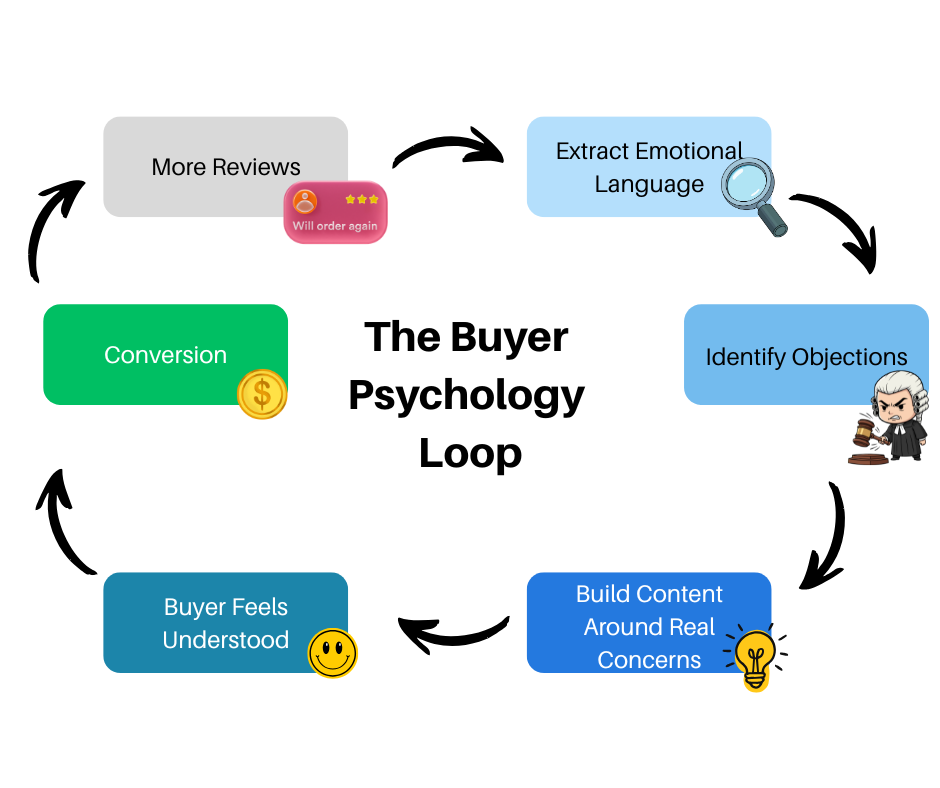
AI helps you:
See patterns faster
Extract emotional language
Spot objections
Identify buying triggers
But the real magic happens when you turn those insights into structure.
Headlines.
Subheads.
Charts.
FAQs.
Emails.
Pins.
When your content mirrors the internal dialogue of the buyer, it stops feeling like marketing.
It feels like understanding.
And understanding converts.
Common AI Research Mistakes to Avoid
AI is powerful.
But used incorrectly?
It just makes you wrong faster.
If you want to position yourself as a smart affiliate — not a hype-driven one — you need to avoid these common traps.
Tools don’t create authority. Judgment does.
Mistake 1: Summarizing Instead of Extracting Signals
This is the biggest one.
Most people paste reviews into AI and say:
“Summarize these.”
And AI does exactly that. It gives you:
General pros
General cons
A neat little overview
That’s not research.
That’s compression.
You don’t need a summary.
You need signals.
Signals are:
Emotional spikes
Repeated frustrations
Hesitation language
Comparison triggers
“Finally” moments
Price justification
Instead of asking for a summary, ask:
What patterns repeat?
What emotional language shows desperation or relief?
Where did buyers hesitate before purchasing?
What made them say “worth it”?
Summaries flatten nuance.
Signal extraction reveals buying psychology.
Big difference.
Mistake 2: Using Only 5-Star Reviews
Five-star reviews are validation.
They are not insight.
They usually say things like:
“Love it!”
“Works great!”
“Highly recommend!”
Helpful? Yes.
Strategic? Not really.
If you only analyze five-star reviews, your content will sound like:
“People love this product.”
That doesn’t convert skeptical buyers.
Real buyers are rarely fully convinced when they land on your page. They’re in evaluation mode.
You need to understand hesitation.
Five-star reviews don’t show hesitation.
Mistake 3: Ignoring 3-Star Reviews (The Gold Mine)
Three-star reviews are where conversion intelligence lives.
They usually sound like:
“It’s good, but…”
“I wish it…”
“It works unless…”
“Not for…”
This is where objections surface.
And objections are where conversions are won.
Three-star reviews reveal:
Edge cases
Fit issues
Expectation mismatches
Conditional satisfaction
Who the product is NOT for
If you address those directly in your content, you remove friction before it stops the sale.
When a reader sees:
“Not ideal if you have wide feet.”
They think:
“Okay. This person isn’t hiding flaws.”
Transparency builds trust.
Trust increases conversion probability.
Mistake 4: Treating AI Like an Oracle Instead of an Assistant
AI is not a truth machine.
It’s a pattern detector.
If you treat it like an oracle, you’ll:
Accept vague conclusions
Skip critical thinking
Assume correlations equal causation
Instead, treat AI like a research intern.
It can:
Sort patterns
Highlight themes
Organize language
Identify clusters
But you still decide:
Which signals matter
Which patterns are noise
What angle is strategically strongest
Authority comes from interpretation.
AI accelerates pattern recognition.
You provide strategic judgment.
That’s the partnership.
Mistake 5: Skipping Manual Verification
AI can misinterpret tone.
It can overgeneralize.
It can exaggerate frequency.
Before you build a headline like:
“Everyone Complains About X”
Verify.
Go back to the raw reviews.
Confirm:
Is this complaint truly frequent?
Is it concentrated in older versions?
Was it resolved in newer models?
Is it actually user error?
Manual verification keeps you honest.
And honesty protects your brand long-term.
Quick wins aren’t worth eroded trust.
The Bigger Principle
Smart affiliates don’t use AI to replace thinking.
They use AI to expand visibility.
You’re not trying to generate content faster.
You’re trying to understand buyers deeper.
Avoid these mistakes, and AI becomes:
A research accelerator
A competitive edge
A conversion amplifier
Make these mistakes, and it becomes:
A summarization machine
A content duplicator
A noise multiplier
Authority isn’t about using AI.
It’s about using it better than everyone else.
Your 20-Minute Execution Checklist
Here’s a condensed version of everything we’ve gone over that you can use as a checklist every time you make content.
The AI Research Sprint (Run This Every Time)
Before you write, do this:
Validate product demand
Pull 30–50 mixed reviews
Run the signal extraction prompt
Fill in:
Pain themes
Desire themes
Objections
Buying triggers
Analyze 2 competitor posts
Identify 2–3 ignored concerns
Build your outline around those gaps
If you skip this step, you’re guessing.
If you run it, you’re positioning.
Research Beats Hype
Affiliate marketing has a noise problem.
Everyone is chasing trends.
Everyone is publishing “best of” lists.
Everyone is trying to move faster than the algorithm.
But speed without insight doesn’t convert.
The affiliates who win aren’t the loudest.
They’re the ones who understand buyers best.
They know:
What buyers are frustrated about
What they’re skeptical about
What they secretly hope will work
What made them hesitate
What finally made them click “buy”
That understanding doesn’t come from copying competitors.
It comes from studying real behavior.
That’s where AI changes the game.
Not because it writes articles faster.
But because it lets you:
Analyze dozens of reviews in minutes
Extract emotional patterns
Surface hidden objections
Spot overlooked buying triggers
AI doesn’t replace research.
It compresses it.
It gives you leverage.
And when you combine that leverage with strategic thinking — when you use it to uncover real buyer psychology instead of generating generic content — it becomes your unfair advantage.
While others publish faster…
You position smarter.
While others summarize…
You extract signals.
While others chase hype…
You follow evidence.
And evidence converts.
Stop Guessing What Converts. Start Seeing It.
Most affiliates write first and hope it converts later.
Smart affiliates validate first.
If you want a structured way to:
Validate niches before you invest time
Analyze real buyer intent
Extract emotional buying signals
Identify underserved pain points competitors ignore
Build conversion-focused content from research
Then you need more than theory.
You need a system.
👉 Get the Affiliate Profit Prompts: AI Starter Toolkit
Inside the toolkit, you’ll get the exact prompts and frameworks used to:
Analyze reviews for conversion signals
Spot buying triggers and objections
Reverse-engineer competitor weaknesses
Turn research into headlines, outlines, and monetization angles
Build repeatable affiliate workflows
No fluff.
No spammy automation tricks.
Just structured, strategic prompts designed for affiliates who want to think better — not just publish faster.
Not Ready Yet? Start Free.
If you’d rather begin with a guided experience, join the newsletter and get the free:
7-Day AI Niche Finder Challenge
Inside you’ll:
Validate a niche step-by-step
Decode buying signals from real reviews
Identify underserved demand
Build your first conversion-focused content plan
It’s practical.
It’s structured.
And it will change how you approach affiliate research.
Research beats hype.
Now you have the tools to prove it.